US Highway 50
The Lake Tahoe Wagon Road
Background
US 50 has the distinction of being one of the last transcontinental
highways to remain intact. It is also a very historic route that has played a key role
in the development of the US West. Most notably, it was the first state
highway in California when it was incorporated into the system in 1895
as the "Lake Tahoe Wagon Road." It also formed the western portion of the
historic Lincoln Highway, the first true transcontinental highway route. Most people know
it by its title, "The Loneliest Road in America." The State of Nevada is proud
enough of this distinction to have created markers on the road to signify this fact.
However, it is important to remember that it is only the stretch through Nevada that is
lonely; as the magazine cover attests, US 50 tells the story of America. The authors of
the accompanying article followed it from coast to coast and used it as a backdrop for
their story. It is easy to see how US 50 has endured as one of the most interesting of the
historic highways that goes through California and the United States. |
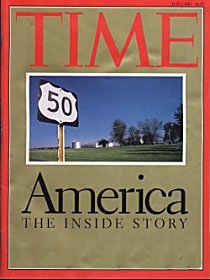
US 50 featured on Time Magazine.1
©1997, Time-Warner |

US 50 At A Glance
Original Routing
US 50 started in San Francisco at the intersection of Harrison and 10th
Streets and went over the Bay Bridge to Oakland. From there it followed the general route
of I-580, I-205, I-5 and SR-99 to Sacramento. Beyond Sacramento, US 50 has been built as
freeway/expressway along new alignments, though east of Placerville it
closely follows it's original routing through the Sierras, with the high point still being Echo Summit.
Outside of California, US 50 is mostly separated from Interstates which has allowed it
to retain many of its older characteristics. It crosses through the heart of the United
States and offers a complete taste of all this country has to offer. A highlight is that
along with US 1 it goes along both sides of the Capitol Mall in Washington, D.C.
Current Status Outside of California
Almost all of US 50 remains outside of California save for the sections that have been
rerouted along Interstate Highways. A part of US 50 east of Washington, D.C. has been
designated as I-595. However, the indication is that it will remain signed as US 50; the
Interstate designation was used primarily as a means of funding the freeway improvements
for that section. Its eastern terminus continues to be and will remain North Division St
and the Boardwalk in Ocean City, MD. Thanks to Mark Eisner for the information about
the East Coast portion.
Current Status in California
US 50 is one of the few US highways to have been kept intact in California. At one
point it had extended to San Francisco, but with the completion of its successor
Interstate Highways in the early 1970s, its terminus was brought back to Sacramento.
Interestingly its terminus in West Sacramento at I-80 is close to the original one in
1926. While many parts of the old road have been incorporated into the Interstate Highways
that replaced it, there are still many sections remaining all along its route that are
worthy of attention.
Intersections With Other US Highways
- US 101 in San Francisco
- Co-routed with US 40 from US 101 to the eastern approach of the Bay Bridge in Oakland
(1934-1964)
- US 99 from Stockton to Sacramento.
- US 50A in Pollock Pines*
- US 50A at the foot of Meyers Grade, west of Lake Tahoe.*
- US 395 in Carson City, NV
*"US 50A" is not an actual state operated US highway nor is it an AASHTO
approved route. It is included due to the novelty of it being signed exactly like a
California state or US route.
US 50 Guide
The US 50 Guide will have detailed descriptions of its old routings and
what remains today.
US 50 Photo Album
Future
Other US 50 Pages
Since US 50 was such an important road, there are several web pages dealing with it.
![[Historic Highways Logo]](../logos/small_hcuh_banner.gif)
Go to the Historic California US Highways Main Page
If you have any questions, comments, or if you would like to send me any updates or
pictures, please contact me at: casey@gbcnet.com.
http://www.gbcnet.com/ushighways/US50.html
1 The cover is (c)1997 by Time Warner and all their rights are
reserved.